
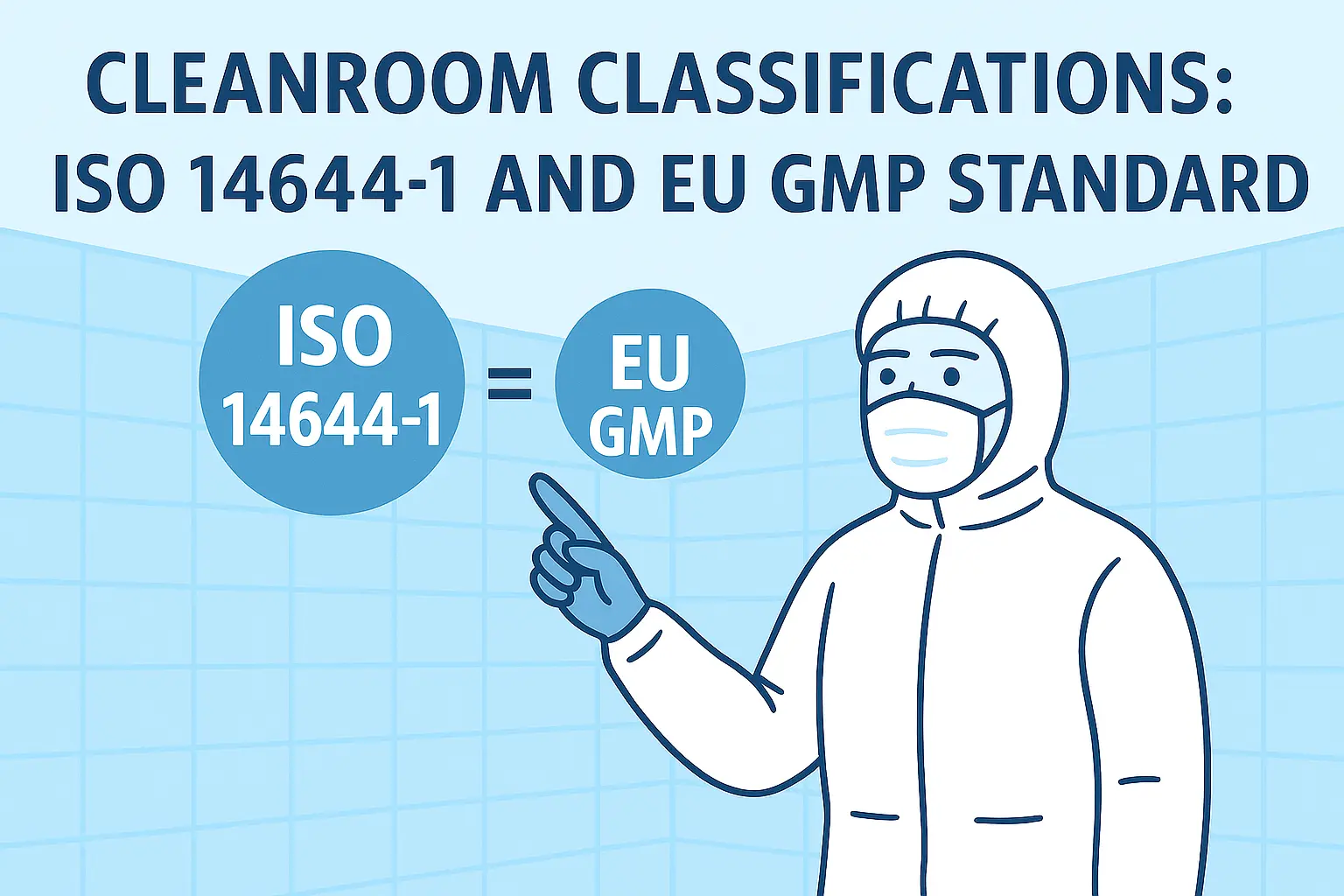
Cleanroom Classifications: ISO 14644-1 and EU GMP Standards
Cleanroom classifications are standardized measures that define the cleanliness level of controlled environments. The most widely recognized classification system is ISO 14644-1, which categorizes cleanrooms based on the concentration of airborne particles. This framework is essential for pharmaceutical manufacturers to ensure that their production environments meet the required standards for product quality and regulatory compliance.
ISO 14644-1 Classification System
The ISO 14644-1 standard classifies cleanrooms from ISO Class 1 (most stringent) to ISO Class 9 (least stringent) based on the maximum allowable concentration of particles per cubic meter of air. The classification is determined by measuring particles at specified sizes, typically ranging from 0.1 to 5.0 micrometers.
Key ISO Classifications for Pharmaceutical Applications
- •ISO Class 5: Equivalent to EU GMP Grade A and US FED STD 209E Class 100. Used for critical processes such as aseptic filling and sterile product handling.
- •ISO Class 6: Equivalent to EU GMP Grade B (at rest) and US FED STD 209E Class 1,000. Often used as background environments for ISO 5 zones.
- •ISO Class 7: Equivalent to EU GMP Grade C and US FED STD 209E Class 10,000. Commonly used for less critical pharmaceutical manufacturing operations.
- •ISO Class 8: Equivalent to EU GMP Grade D and US FED STD 209E Class 100,000. Used for packaging areas and other supporting functions.
Relationship Between ISO and EU GMP Classifications
While ISO 14644-1 focuses primarily on particle concentration, the European Union's Good Manufacturing Practice (EU GMP) classification incorporates additional microbiological requirements. Understanding the correlation between these systems is crucial for pharmaceutical manufacturers.
EU GMP Grade A (ISO 5)
High-risk operations such as filling, stopper bowls, and other open aseptic manipulations. Requires unidirectional airflow with velocity of 0.45 m/s ± 20% and specific microbiological limits.
EU GMP Grade B (ISO 5/6)
Background environment for Grade A zones in aseptic preparation and filling. Has the same particle limits as Grade A at rest but different limits in operation.
EU GMP Grade C (ISO 7)
Used for less critical stages in the manufacturing of sterile products, such as preparation of solutions to be filtered.
EU GMP Grade D (ISO 8)
Used for preparation of components and materials that will undergo terminal sterilization.
Cleanroom Testing and Certification
Maintaining cleanroom classification requires regular testing and certification according to ISO 14644-2. Key testing parameters include:
- •Particle Counting: Measuring the concentration of airborne particles at specified sizes using calibrated particle counters.
- •Air Velocity and Volume: Testing airflow patterns, velocities, and air change rates to ensure proper ventilation.
- •Filter Integrity: Verifying the integrity of HEPA/ULPA filters using established test methods such as DOP or PAO challenges.
- •Room Pressurization: Measuring pressure differentials between adjacent spaces to confirm proper cascade.
- •Temperature and Humidity: Monitoring environmental conditions to ensure they remain within specified ranges.
Conclusion
Understanding cleanroom classifications is essential for pharmaceutical manufacturers to design, build, and maintain facilities that meet regulatory requirements and ensure product quality. By selecting the appropriate ISO classification for each manufacturing area and implementing robust monitoring programs, manufacturers can establish controlled environments that support their specific production needs.
Terracos specializes in designing and constructing cleanrooms that meet precise classification requirements for pharmaceutical applications. Our engineering team can help you navigate the complexities of cleanroom standards and implement solutions that achieve and maintain your required cleanliness classifications.